

Summary
- Wert Intelligence’s keywert is an AI service capable of searching, classifying, and summarizing over 300 million global patent data entries.
- L&F integrated ATOM™ (a domestic AI semiconductor) with keywert powered by PlutoLM (a domestic AI model) to establish a domestic technology-based AI full-stack service within the IP data curation (AI of Science) domain.
- Demonstrated operational efficiency with a 2.8x improvement in power efficiency and a 16% increase in inference speed compared to legacy GPUs.
Challenge
To accelerate R&D innovation in core materials for secondary batteries, L&F has been evaluating the adoption of an IP service capable of efficiently searching, classifying, summarizing, and analyzing global patent data. Because technical documents and research outputs related to cathode materials are confidential assets containing the company’s core competitiveness, an on-premises environment that can process data securely indoors without exporting data to an external cloud was a mandatory requirement.
Patent data-based IP services are inherently data-intensive, focusing on search, classification, summarization, and analysis; therefore, processing performance and efficiency directly impact R&D productivity. keywert, operated by Wert Intelligence, is an AI service that handles over 300 million global patent data entries, including technical information. Recently, there has been a surge in demand for on-premises deployment to securely analyze confidential data such as corporate R&D outputs. L&F required an infrastructure capable of running keywert’s analytical capabilities stably and cost-effectively within an internal air-gapped network environment.
Solution
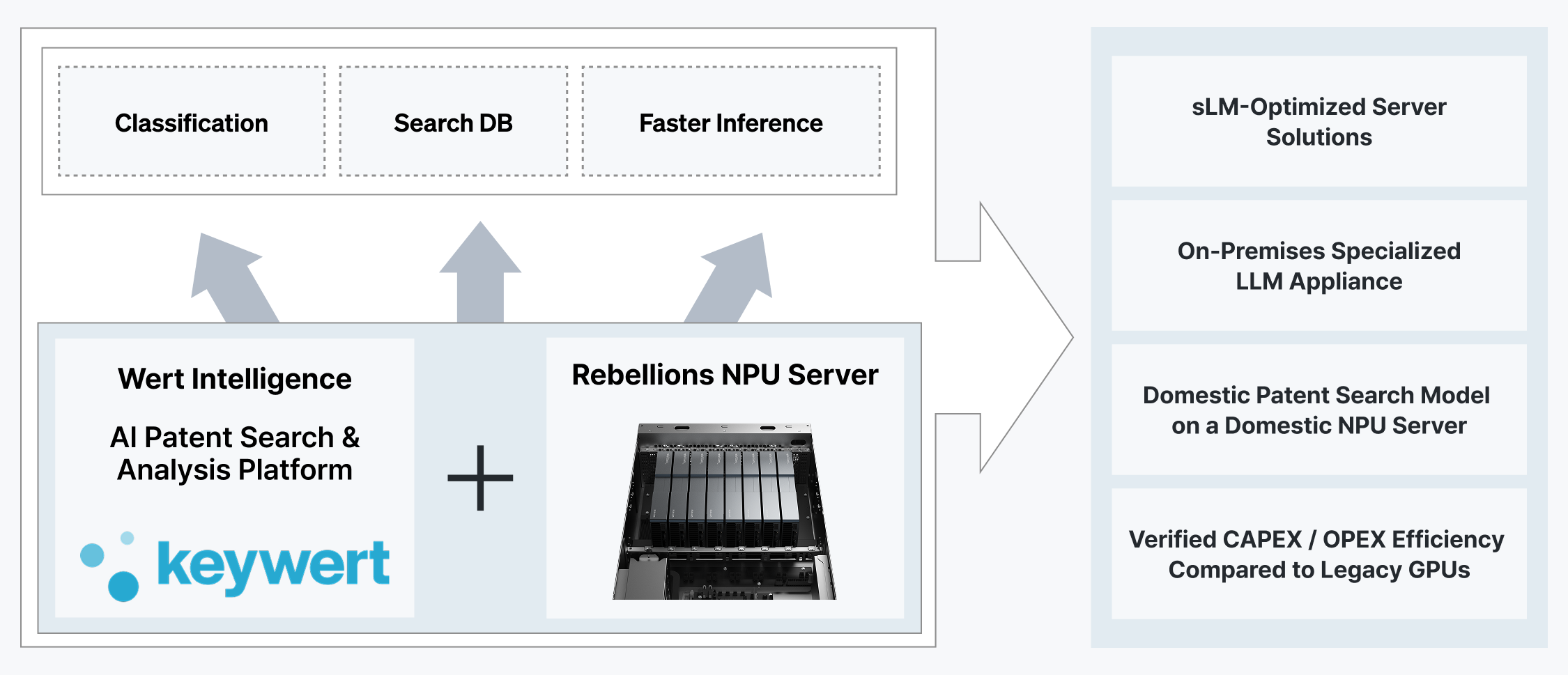
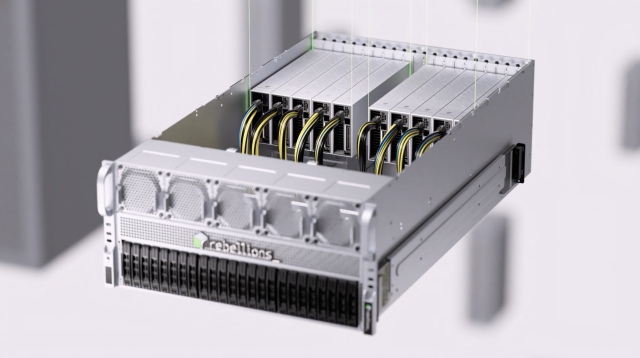
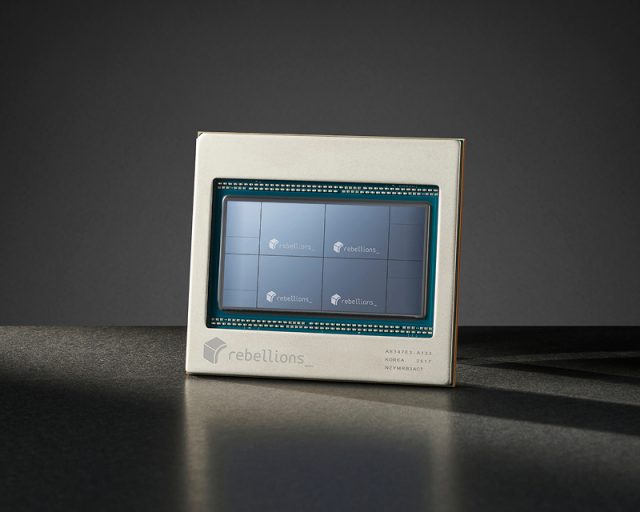
Wert Intelligence signed a Memorandum of Understanding (MOU) with Rebellions, a company specializing in NPU, to build an NPU-based full-stack solution that integrates the domestic AI semiconductor ATOM™ with the AI model PlutoLM. This solution executes PlutoLM on ATOM™ and is designed to perform inference operations on more than 300 million global patent data entries.
The core functionalities consist of two components: the AI Classification Copilot and the AI Summarization Copilot. The Classification Copilot automatically categorizes hundreds to thousands of remaining patents within seconds after a user labels a minimum of 10 documents. It is configured with a chatbot-style classification guide to precisely reflect the user’s intent and classification criteria, while also enabling the configuration of the inference scope. The Summarization Copilot recognizes and extracts core content, such as technological objectives, technical solutions, and novelty, from patent documents, and is designed to serve as a tool for discovering new functions and materials.
At L&F, the full-stack package integrating the AI model, data, and infrastructure was deployed on-premises as an internal server architecture. Based on approximately 1,500 training data samples selected from a seed dataset of around 100,000 patents related to secondary battery cathode materials, the system is structured so that the Classification Copilot and Summarization Copilot collaboratively classify constituent substances within patent document paragraphs and perform summarization.
Result
L&F established a framework to securely operate workloads up to automated new patent notifications within an air-gapped on-premises environment, enabling the immediate utilization of AI inference results in patent analysis tasks for secondary battery cathode materials. In quality validation assessments conducted by domain experts, including patent attorneys, the system recorded an average satisfaction score of over 7 out of 10, demonstrating its operational utility.
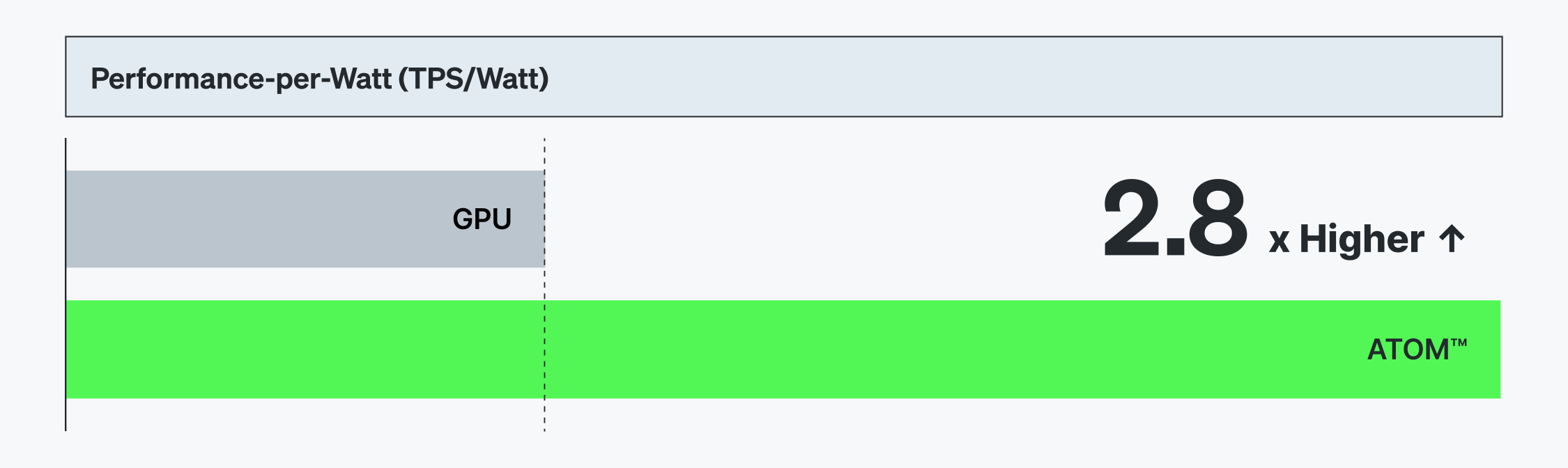
Clear performance metrics were observed. By adopting the Rebellions NPU, the performance-per-watt (power efficiency) improved by approximately 2.8 times compared to legacy GPUs, reducing deployment and operational costs, while the inference speed increased by more than 16% compared to the existing system. This case demonstrates that a high-performance AI inference environment can be implemented using entirely domestic technologies, spanning from infrastructure to application services, within the security-critical field of IP data curation (AI of Science).
“This collaboration is significant because it establishes a foundation for patent AI to operate with higher speed, stability, and cost-efficiency in industrial settings. By combining our models with Rebellions’ NPU infrastructure, we will expand patent AI into a core corporate decision-making infrastructure and continue to demonstrate its competitiveness in the global market.”
– Jungho Yoon, CEO of Wert Intelligence –
Appendix: NPU User Guide
Get Started: Prepare pre-trained model → Compile model using RBLN compiler → Load compiled model and run inference
- PyTorch BERT-base Tutorial → View Example
- Optimum RBLN Library EXAONE Model API → View Example
- Llama3.1 8B Model Serving via vLLM → View Example
- C/C++ Runtime Text Generation → View Example





Share This: